Thursday, February 11, 2016

Postscript to Populism vs Technocracy

I spent my last post beating up on a Vox article, so as a postscript let me praise this one, where Ezra Klein interviews Obama's 2008 staffers about the similarities and differences between their campaigns. What particularly stood out to me was his email interview with Obama's speechwriter at the time, Jon Favreau. In 2008, one thing Obama said was, "It's time to let the drug and insurance industries know that while they'll get a seat at the table, they don't get to buy every chair." Favreau explains:
To me, this exemplifies the difference between Bernie and Obama. Bernie would never say something like that. He doesn't think insurance companies, or drug companies, or banks, or millionaires get any seats at the table. He doesn't talk about making progress by working with Republicans, or the political establishment, or the business establishment. I guess his plan is to build a mobilized grassroots that simply wrestles power away from those who have it. 
It's not just that Obama doesn't think that's feasible, it's that he doesn't think that's the right way to govern in a pluralistic democracy where everyone gets a voice. Obama believes that there's too many Americans who don't have a voice, and too many Americans who don't have opportunity, and that a big reason for that is the power of special interests and big corporations. But he also believes that there's a place for those interests and corporations in our system.
Note, again, that combination of criticisms: populism is both infeasible and undesirable. However, Favreau clearly isn't very interested in the feasibility critique. Instead, he explicitly says that Obama (and by extension Favreau) thinks special interests and big corporations should have some power, just not as much as they have right now. And Obama indeed enacted that policy as President; there are numerous examples I could site, but this secret deal he made with the pharmaceutical companies before the healthcare fight is the most blatant one.

This is technocracy in action. Favreau says that Bernie doesn't want special interests or big corporations to "get any seats of the table." That, though, is an exaggeration; it's not like Sanders is proposing to disenfranchise the rich. He doesn't want to deny seats to the big corporations, he just wants them to have the same seats as everyone else. Favreau (and according to him, Obama), on the other hand, want the rich and powerful to remain more powerful than the marginalized--just somewhat less powerful than they currently are. (Again, keep in mind he's arguing this state of affairs is desirable, not inevitable.) It's...interesting...that he claims to be defending "pluralistic democracy" while advocating an explicitly anti-democratic and anti-egalitarian worldview.

While Favreau doesn't justify his position, I think it's fair to say it comes from the technocratic attitude I discussed in my previous post. Consider his characterization of Sanders's proposal: "to build a mobilized grassroots that simply wrestles power away from those who have it." Favreau seems to conceive of populism as a kind of violence: wrestling power away from the powerful. And honestly, he's kind of right. As Klein says later in his article:
In this telling, the core difference between Obama and Sanders is that Obama's theory of political change was that American politics needed to become less ideological and less conflictual, while Sanders's theory of change is that American politics needs to be made more ideological and more conflictual.
This is precisely right. Mass movements are extremely ideological and conflictual. Sometimes they become literally violent, but even when they don't things like protests and boycotts are basically attempts to coerce others into doing what you want them to do. Technocracy by contrast, if only because there are far fewer people involved, is transactional, consensus-based, sometimes even polite. It is also, of course, undemocratic. But for some, that's a cost worth paying, or even perhaps not a cost at all.

I'll try to write something for this Sunday. Not sure what yet. Suggestions are welcome.

Monday, February 8, 2016

Hillary Clinton is not (just) a pragmatist: she's a technocrat

I

David Roberts of Vox recently wrote a post about the Democratic primary, inspired by the recent kerfuffle about whether Clinton is a "progressive." Roberts calls the idea that one cannot be both a moderate and a progressive an "illuminating error" which "helps expose a key source of misunderstanding between the Clinton and Sanders camps." Ironically, in explicating this "error," I think Roberts makes an illuminating error of his own in asserting that the main difference between Clinton and Sanders is the former is a pragmatist ("a progressive who gets things done," perhaps), and the latter isn't. In reality, though, they're both pragmatists, it's just their theories of change are different: Sanders is a populist, while Clinton is a technocrat. Before explaining what I mean by that, though, I want to summarize Roberts's argument.

Roberts argues that there are (at least) two ways one can assess a political candidate: their ideology and their "practicality." Roberts writes:
"Progressive" is an ideological term. It refers to a position on an ideological spectrum, namely to the left. A progressive's opposite is a conservative. 
"Moderate" is a practical term. . . . Broadly speaking, it refers to a candidate who focuses on consensus-building and incremental progress, someone who doesn't believe the US political system is capable of sudden, lurching change, or just doesn't want that kind of change. 
A moderate's opposite is a radical, someone who believes rapid, revolutionary change is both possible and necessary.
(Note how Roberts conflates two senses of "moderate": someone who believes rapid change is impossible, and someone who believes it's undesirable. I'll come back to this later.)

Roberts claims Sanders prefers talking about ideology (what he wants to do), while Clinton prefers talking about practicality (what it's possible to do). As a result of this, arguments between each faction tend to be unproductive. Sanders supporters "reject out of hand" the notion that "Clinton and her supporters might believe equally in the values of the left but differ on strategy." Similarly, Clinton supporters interpret any "expression of ambition" as "a lack of knowledge about How Politics Really Works."

Despite this try at even-handedness, Roberts's sympathy with the Clinton side of this debate is clear. He writes:
But over time, I have grown extremely skeptical, not to say cynical, about the capacity of US political institutions to deliver dramatic change. And I've witnessed the cycle of hyperbolic liberal hopes followed by melodramatic liberal despair too many times.
Roberts admits that the "reality" he's expecting liberals to accept is "creeping oligarchy and militarism," and that "on climate change alone, something like a revolution seems necessary." However, his final point is that even if we need a revolution, the President isn't the person we should look to for one:
The president is constrained by layer after layer of checks and balances, veto points, entrenched interests, and institutional inertia. For a president in polarized times, progress comes not with a bludgeon but with a chisel. 
The reason the left's revolution hasn't arrived isn't just that money has corrupted Washington, though it undoubtedly has. It's that half the country views massive new taxes and government spending programs with horror. . . . Resistance is not futile, but it is painstaking.
While I have some nitpicks with Roberts's argument--Sanders certainly has explained what he means by "political revolution" whether you agree or not, and a majority of the country supports (for example) single-payer health care--my biggest issue is with his starting distinction between ideology and practicality. This is the "illuminating error" I referred to, which I will now discuss in detail.

II

To begin with, recall that Roberts gave two different descriptions of a "moderate": one who believes radical change is impossible, and one who believes it's undesirable. Considering Roberts's overall article, he seems to put himself in the former camp. However, this camp is objectively incorrect. Here are just a few examples of radical change that have occurred throughout American history:

1) In the late 1700s, the entire system of American government (rule from Britain) was overthrown and a new one was drawn up from scratch.
2) In the mid to late 1800s, slavery, the foundation of the American economy, was abolished.
3) In the early 1900s, half of the population was given the right to vote for the first time, permanently affecting American politics to this day. (In 2012, Obama won the female vote 55% to 44%.)
4) In the mid 1900s, the economy was fundamentally transformed again, setting the stage for a massive rise in median family income.
5) In the mid to late 1900s, the system that had been set up to oppress black Americans after slavery, which had lasted for a century, was overthrown along with much of patriarchy.
6) In the late 1900s, a backlash occurred and we swung back to the right, a process that is currently ongoing.

To be fair, these changes were not always pretty; for example, the first two were ultimately accomplished by wars, and the New Deal would not have happened without the Great Depression. Furthermore, the successes were often mixed: after the American Revolution only white male property-owners could vote; racism and sexism continue to be pervasive; the New Deal often explicitly excluded people of color from its benefits. Nevertheless, they are surely far more radical than Sanders's major proposals, all of which already exist in other countries (and some of which, like free college, used to exist in this country). One is forced to wonder where Roberts's cynicism about fundamental change comes from, especially since the last one--the conservative revolution--is so recent.

Perhaps Roberts thinks the country has just fundamentally changed since the 1960s: it's too divided now, the special interests are too strong. However, this notion is ridiculous. Segregation was supported by half the country and centuries of history. Slavery was the backbone of the American economy, backed by some of the richest and most powerful individuals ever to exist. If anything, the enemies of progressivism's past were more powerful than the enemies of progressivism's present.

I suspect the source of Roberts's discomfort resides elsewhere. There is an important commonality between all six instances of radical change I cited: they were all accomplished by massive popular movements. This includes the American Revolution, which was preceded by decades of protest, boycotts, and rioting. (They looted the mansion of the pro-British lieutenant governor of Massachusetts.) Not coincidentally, this is precisely Sanders's strategy for enacting change:
"But if, on that very day, as an example," [Sanders] continued, "a million young people march in on Washington to say exactly what Colleen said a few moments ago, that all of our young people who have the ability deserve to get a college education regardless of the income of their families, suddenly, that gentleman will look out the window and say, 'Well, Mr. President, let's sit down and talk about how we can address this serious problem.'"
This strategy has its flaws. As the above Slate article points out, cheap fossil fuels benefit millions of Americans (not just oil companies), so it may be difficult to build a mass movement against global warming. More fundamentally, one could argue that the very notion of an anti-establishment movement led by the President of the United States is a contradiction in terms, and that to be truly independent and long-lasting we need to organize around issues, not personalities. While I am myself a Sanders supporter, I think both these objections are plausible and on-point. Nevertheless, it seems clear that a mass movement does have the capability of forcing radical change, and so the only way one can argue that only incremental change is possible is if one takes mass politics off the table.

And indeed Roberts, despite his disclaimers in support of activism, doesn't seem at all interested in the question of how to build a durable left-wing mass movement. I wonder, then, if Roberts might fall into the second camp of "moderate": someone who believes radical change is undesirable. Not necessarily because they disagree with radical change as an end goal, but because they disagree with the means necessary to achieve this.

Roberts argues that Sanders and Clinton both share the same goal, they just disagree on how to achieve it. Well, perhaps a Dictator Sanders and a Dictator Clinton wouldn't look very different. But who cares? Neither are running for dictator. In the actual world, it is impossible to draw such a clean line between someone's "ideology" and their "practicality." Sanders and Clinton disagree on tactics, yes, but this disagreement is based on a deeper ideological difference: Sanders believes that change should be achieved by a mass movement, while Clinton believes that change should be achieved by a small group of experts. In short, Sanders is a populist and Clinton is a technocrat. Their ideologies determine which tactics they consider acceptable.

III

My use of the terms "populist" and "technocrat" may be unclear and is probably idiosyncratic. So first I'll explain a bit what I take those terms to mean, and then I'll back up my claim that Clinton is a technocrat.

A technocrat believes that politics is, at bottom, a science. As such, in an ideal state, politics would be handled by trained experts. These experts would, non-ideologically, determine which policies would lead to the most benefit/greatest welfare for the country, and would then enact those policies. This is not to say that technocrats have no use for the public--however, by necessity the public must play a subordinate role. Namely, the purpose of sympathetic popular movements is to advocate for the policies that the experts come up with and to pressure those who oppose those policies (either through ignorance or maliciousness). What they must not do is pressure the experts themselves, because while the experts might not always be right, due to their expertise they are more likely to be right than the uneducated public.

I should note that, while I disagree with it, technocracy is not implausible on its face. After all, in most areas of our life (medicine, law, etc) we consult experts to decide what to do. Why should politics be any different?

I think the best way to describe the opposite view, populism, is that a populist thinks politics is at bottom a struggle. More specifically, it's a struggle between the powerful and the non-powerful, or marginalized. Since the marginalized are typically more numerous than the powerful, a populist's main task is to encourage the marginalized to unite and organize, in order to gain power and defeat the powerful. To a populist, the "non-ideological experts" the technocrat values so much are in fact part of the powerful--they are ultimately enemies, not saviors (though some may occasionally be tactical allies). In the populist's ideal state, the public, and not a small group of experts, would rule.

In my opinion, the best argument in favor of populism and against technocracy is that there's no such thing as a non-ideological expert. Depending on what you value, your theory on what counts as the "general welfare" will differ. So while technocrats claim to merely be non-ideologically--or "pragmatically," if you will--doing "what works," in reality they are imposing their own set of values on the rest of society. This, in my view, is really a form of tyranny. But then, as a Sanders supporter, I suppose I would think that. And technocracy has a long tradition, arguably starting with Plato, so it's not like all technocrats are evil or even ignorant. And to be fair, history shows that mass movements often end up supporting vile policies and politicians, so I can certainly understand the motivation behind technocracy even though I disagree.

Anyway, it's pretty clear that Sanders is a "populist" in my sense: he's explicitly calling for a mass movement to pressure both parties to enact his favored policies. What about Clinton, though?

Well, we can't peer into her soul, and as far as I know she hasn't explicitly endorsed either position. Nevertheless, I think she's almost certainly a technocrat, due in part to: her reliance on big donors, her rejection of radicalism and advocacy of incrementalism, and her alignment with the Democratic establishment. I will argue this next.

IV

Clinton giving speeches to banks for hundreds of thousands of dollars has become an issue recently, compounding the previous issue of her using a SuperPAC, fundraising from large corporations, etc. Her response has been, essentially, that she's never changed a vote due to a campaign contribution. This may be true, but it's essentially beside the point. As Alex Pareene points out in this excellent Gawker article:
Bernie Sanders' critique of Clinton is not that she's cartoonishly corrupt in the Tammany Hall style, capable of being fully bought with a couple well-compensated speeches, but that she's a creature of a fundamentally corrupt system, who comfortably operates within that system and accepts it as legitimate. Clinton has had trouble countering that critique because, well, it's true. It's not that she's been bought, it's that she bought in. [Emphasis added.]
Clinton took offense at the recent debate to being called part of the establishment. But the "establishment" isn't a single entity, it's a catch-all term to describe the powerful entities in a society, and as one of the most powerful people in the country Clinton is certainly a member of the establishment, at least the Democratic one. (Indeed, her pitch as being an "experienced progressive who gets things done" is based on this membership.) The Democratic establishment has decided that to succeed it must work with other powerful entities, like big corporations, rather than fight them. By relying on money from these powerful corporations, Clinton is clearly using the same strategy.

This strategy is a technocratic one, both for what it does and what it does not do. While CEOs and other rich individuals may not seem like "experts," according to modern capitalist mythology anyone who makes it big is intelligent, hard-working, knowledgeable, etc. This is the justification behind hiring rich employees of these firms to important government positions: they are the savvy ones who know what to do. The Platonic philosopher-king has become a CEO.

Even more importantly, though, is what the strategy doesn't do: namely, it's not even trying to rely on left movements. This is where incrementalism (and thus, the original Vox article by Roberts) come into play. Roberts asserts that only incremental change is possible in our modern political system. Clinton herself and many of her supporters agree. But as I've argued, this is only true if one preemptively declares mass politics--that is, populism--untenable. Since mass politics can clearly work, this makes sense only if Clinton believes populism is undesirable, that we shouldn't make a strong left mass movement even though it would be effective. Thus, while he might not be aware of it, Roberts is effectively advocating for technocracy in his article, and Clinton (who probably is aware of it) is advocating for technocracy in her campaign.

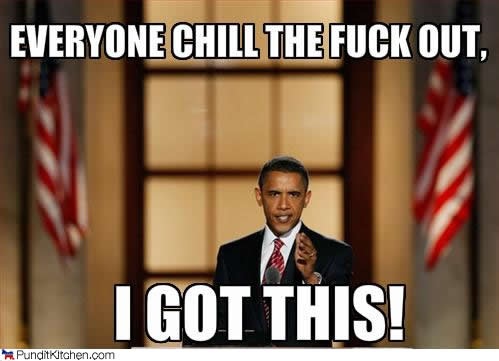
And this shouldn't be a surprise, because technocracy is the main strategy of the Democratic establishment. There are far too many examples of this to list, but the most revealing is the actions of Barack Obama, the President whom Clinton has more or less promised to be the 3rd term of. Obama got elected President partly on the back of a large and enthusiastic movement. But rather then try to build it into an independent force that could pressure Congress, even its Democratic members, even Obama himself, in a liberal direction, Obama basically put it on ice until he wanted to use it to advocate for the end result of his legislative sausage-making. Anyone remember this?

ZZ7A3474E6.jpg

This image was all over the place in 2009, and while it's not used much anymore the sentiment that goes with it surely is. Let Obama handle things; our role as citizens, if anything, is merely to support whatever policies and laws he decides on. This is, of course, a fundamentally technocratic way of conceiving politics. And while it's possible that Clinton will repudiate it and enthusiastically support any left movement that might emerge, I'm not holding my breath.

(Disclaimer: It is true that Democrats have been largely respectful of the Black Lives Matter movement. This is because they have to be, as BLM has built for itself a lot of power, both political and cultural. But if BLM starts seriously going after Democrats who are recalcitrant on police reform [aside from disgraced mayor Rahm Emanuel], I expect this to change. But we'll see.)

V

So where does this leave us, then? Sanders is a populist while Clinton is a technocrat, and since populism is correct you should vote Sanders?

Not precisely. There is danger in a Sanders-led mass movement: even if Sanders were a perfect politician (which he's far from being), the movement would dissipate as soon as he leaves office. But it takes decades, at least, for a truly radical movement to succeed in even some of its goals. (The conservative movement began after WWII and only really "won" in 1980, if that. The Civil Rights movement arguably began shortly after the Civil War, which means it took almost a century of activism to tear down Jim Crow.) A left movement cannot be a "Sanders movement"; it needs to be independent of any politician.

Which leads to the question: assuming we can form a left mass movement, does it really matter that much who's President? Would a President Clinton under constant pressure from a left movement be that much different from a President Sanders under constant pressure from a left movement? Perhaps not--in which case, one could accept my entire analysis while still preferring Clinton for other reasons (electability, the symbolic value of a female President, etc).

Despite my clickbait title, though, this article is not ultimately about the Clinton/Sanders primary. What bothers me about Roberts's Vox article, and countless similar ones, is not that it's pro-Clinton but that it's pro-technocracy. A technocrat cannot change the status quo because they disdain the only thing they can. For anyone who believes the status quo is unacceptable, a mass movement is necessary and technocratic incrementalism must be rejected. No matter who wins this November.

Friday, January 8, 2016

Preview: The Left and Presidential Politics

This Sunday, I think I'm going to talk about Presidential politics; specifically, the attitudes the modern American Left take toward it, and how they are fundamentally mistaken. While there are many reasons behind the undeniable fact that the Right is much more effective at politics than the Left in America since at least the 1970s, the different ways they approach presidential elections (and elections more broadly) is at least the most easily fixable, so it seems a good place to begin.

In the meantime, let me share with you my predictions for the 2016 Presidential race:
-Hillary Clinton will be the Democratic nominee.
-Ted Cruz will be the Republican nominee.
-The general election will be close--much closer than the 2008 and 2012 ones were, at least.

I will argue for all three of these points on Sunday. For now, pause to consider that "President Ted Cruz" is a distinct possibility, and just what that says about the state of the modern American Left.

Monday, January 4, 2016

The Tone Argument: What counts as an insult?


I

A contentious issue, both within the "social justice community" (to the extent that's a thing) and in relations between the social justice community and the wider culture, is the "tone argument." The idea is that it's in some sense wrong to criticize the tone of people advocating for social justice, attacking bigotry, etc. As Geek Feminism wiki puts it:
A tone argument is an argument used in discussions, sometimes by Concern trolls and sometimes a Derailment, in which it is suggested that feminist would be more successful if only they expressed themselves in a more pleasant tone. . . . 
The tone argument is a form of derailment, or a red herring, because the tone of a statement is independent of the content of the statement in question, and calling attention to it distracts from the issue at hand. Drawing attention to the tone rather than the content of a statement can allow other parties to avoid engaging with sound arguments presented in that statement, thus undermining the original party's attempt to communicate and effectively shutting them down.
Or, as Katherine Cross puts it in this article:
In rule form, the tone argument might be expressed as follows: Any attempt to discuss or criticize the tone of an activist is a deliberate attempt at leveraging institutional power to silence the marginalized and must be avoided at all costs.
In other words: an argument's tone is separate from its content, so focusing on the former is distracting attention away from the latter. Combine this with the fact, also mentioned by Cross, that anti-bigotry activists (especially those from marginalized groups) are often dismissed as being e.g. too "angry" even when they have extremely valid points, and dismissing criticism of tone as an improper "tone argument" may seem quite reasonable.

However, some argue that the tone argument should not be dismissed out of hand, because sometimes the tone of a social justice activist really is improper, wrong, and hurtful. As Cross goes on to argue:
To put it simply: sometimes someone is being too angry. . . . Sometimes you are just being too loud, abusing people verbally, triggering them, and so forth. Sometimes you are just being a jerk and your tone is a fairly reliable indicator of this.
Or, as George R.R. Martin argued in the context of the Sad Puppies incident last year (which I'm not going to even attempt to summarize right now):
The way I have seen it work, dozens of times now, is that a debate or discussion starts out as a reasonable exchange of ideas, but then grows heated. Tempers fray, names are called, the posts get uglier and uglier... and someone, or maybe a bunch of someones, steps over the line and says something truly cruel or hurtful or just nasty. And the target, or maybe a bystander, objects and says, "no call for language like that" or "can't we all calm down" or something along that line... whereupon a loud cry of "Tone Argument, Tone Argument, Tone Argument" goes up, and person [sic] who called for calm is shouted down or torn apart. 
. . . . 
I applaud the Tone Argument. The Tone Argument is valid. Yay for the Tone Argument. 
We can disagree with each other without attacking each other. And no, I am not going to listen to you if you're screaming at me and calling me offensive names. You shouldn't either, no matter who you are. None of us should have to put up with that shit.
This, too, may seem quite reasonable. If X, in the course of an argument, tells Y to kill themselves, it appears that X has done something wrong and we should criticize X's tone regardless of the quality of their argument (and indeed, even regardless of the quality of Y's character).

Of course, with rare exception, I think most would agree that heartfelt violent rhetoric like that is inappropriate and wrong. One of the difficulties with the "tone argument" is that there are many types of "uncivil" tone, but discussions of the "tone argument" tend to ignore specifics and deal in generalities. Most would agree it is wrong to tell someone to kill themselves (much less to actually threaten violence, rape, etc), while most would agree it's legitimate to merely tell someone their opinion is wrong. The question, then, is where to draw the line.

However, in this post I will argue that it is wrong to draw this line based on what level of vitriolic tone we consider acceptable, and indeed, that insisting on a civil tone and lack of insults actually focuses on entirely the wrong issue. Contrary to the usual justifications for rejecting the tone argument, however, this is not because tone is separate from content and so focusing on tone is derailing. Rather, it is because tone is not separate from content: some kinds of argument are inherently insulting, and so insisting as Martin does that people "disagree with each other without attacking each other" is actually insisting that certain views not be expressed.

To argue this, I will first take a short detour.

II

After the 2008 election, indeed almost immediately after, one of the biggest issues of contention within liberal America became: do you generally support Barack Obama's presidency, or do you generally oppose it (from the left, of course)? The biggest online battlefield between these two camps was (and largely still is) the community blog DailyKos.

I will confess that, sometime during the healthcare reform fight in 2009, I started to lean strongly toward the "critic" camp. But the point of this detour is not that. Rather, I want to focus on one aspect of this fight: in what ways is it acceptable for Obama to be criticized? In particular, many in the "supporter" camp claimed (and still claim) that, while they have no problem with criticism of Obama's policies, they do have a problem with attacks on his character. For example, in a comment on DailyKos, SUNY Professor Ian Reifowitz said:
We should keep criticizing and pushing Obama left, but we must not demonize him, both because he is so closely identified with liberalism (and yes, he is, among the American people at large) and because of what he represents to African Americans as the first black president.
Seeing an opportunity to make a point I had wanted to make for a while (forgive the narcissistic self-citation), I replied:
[W]hat, in your view, is the difference between "criticism" and "demonization"?
Reifowitz replied that "calling him names is demonization," while "content-based criticism" is not. The problem with this, I felt, is that the line between "content-based criticism" and name-calling is not always so clear, so I responded:
For example, let's say one believes that the President's drone program constitutes a war crime. While technically being a content-based criticism, this line of attack essentially calls him a war criminal, which many would consider demonization. Similarly, if one critiques Obama's economic policies and calls them "corporatist," that's easily taken to mean one is calling Obama himself a "corporatist," which again is often taken to be demonization.
While I still think my point was sound (which Reifowitz never responded to, though I was just some nobody commenter so I can't blame him for not engaging in extended argument), I didn't state it as well as I should have. What I should have said is: calling Obama a war criminal is demonizing him; calling his economic policies corporatist (or pro-austerity, conservative, or whatever) just is calling Obama himself a corporatist (austerina, conservative), which--at least on a liberal blog--is also demonization. To put it in broader terms: any harsh criticism of Obama's policies is an insult to him, because if accusing a politician of promulgating evil through their policies is not an insult, nothing is. This means that calls to not insult Obama personally or to not demonize him, while seemingly "neutral" and targeted merely at rhetoric, are in reality calls to not make certain kinds of criticisms. Minor critiques of specific policies are probably OK; broad-based critiques of major policy initiatives are iffy; harsh criticisms are disallowed.

Now, perhaps one might justify such a dictum against too-harsh criticism of Obama, such as Reifowitz's arguments that he's the standard-bearer of liberalism, is symbolically important to black Americans, etc. But at the very least, we should be honest about what we're arguing for: not an end to certain types of rhetoric, but an end to certain kinds of criticism.

Now then, what does this detour have to do with the tone argument?

As I've said, one of the issues here is that people who discuss the tone argument tend to speak in generalities. Cross says that sometimes people are too angry, and are "being a jerk." But when, precisely, is this? Almost by definition, we can agree that it's wrong to be "too angry"--the entire debate is about what counts as being "too angry." Similarly, Martin says that we shouldn't "attack" each other, but what precisely counts as an "attack"?

I'm also speaking in generalities here, so let's get down to brass tacks. Is it wrong to call someone a sexist, or a racist?

As far as I can tell, there are three ways Cross and especially Martin can answer this question:
(a) No, it's not wrong, because "sexist" (or "racist," "homophobe," and the like) isn't an insult.
(b) Yes, it's wrong, but instead you should just say that someone "has sexist/racist views," and that's fine.
(c) Yes, it's always wrong to assert that the person you're talking to is sexist/racist/etc in any way, shape, or form.

I will discuss these possible responses in turn.

III

So the first way someone could answer my question is: "Calling someone a sexist (racist, etc) isn't an insult." To compare, Reifowitz could respond to me in a similar way, that calling Obama a war criminal is fine because that's not an insult.

This hypothetical response by Reifowitz, however, is self-evidently absurd. Calling someone a war criminal is extremely insulting. Indeed, it's safe to say that calling someone a war criminal is more insulting than calling them stupid, or ugly, or other obvious insults. Or, to put it another way, since war crimes are evil, accusing someone of being a war criminal is accusing them of being evil.

"Sexist," "racist," and the like are insults in a similar way. They're not mere labels for ideologies--at least, not anymore. Our modern culture assumes that sexism, racism, and the like are not merely wrong but evil--perhaps less evil than committing war crimes, but evil nonetheless. Thus, calling someone a racist is different in kind from calling someone, say, a "free trader" (outside of certain circles, at least). The latter is an economic policy that we (mostly) think is legitimate to defend; the former is (mostly) considered a scourge that should be wiped out, not debated calmly.

The best proof of the inherently insulting nature of these words is the reaction of those on the receiving end of them. Brad Torgersen, one of the "Sad Puppies" leaders Martin was arguing against, once said:
Words like "racist" and "misogynist" are presently code for "not part of the human equation" thus any man or woman who can be successfully labeled these things, is cut off from polite circles, perhaps even driven out of the workplace, or worse.
I didn't find a similar explicit quote from another major Sad Puppies leader, Larry Correia, but try perusing any of his posts on the topic (such as this one) and it's clear he shares the sentiment.

But really, it's not necessary to deluge you with examples. Observe any internet argument (or real-life argument for that matter) where one of the participants is called a racist or sexist. They will almost inevitably react as if they were insulted, and that's because they were insulted. Racism is frequently referred to as a "disease" or worse. If it's not insulting to call someone a racist, I'm not sure what an insult is.

To be clear: I fully agree that racism is a disease--indeed, that that analogy underplays it--and I think the fact that "racist" (and "sexist" etc) is considered an insult is a sign of great progress. But we need to face the fact that it is an insult. So the first possible response, that it's OK to call people racists because that's not an insult, is a complete non-starter.

IV

The second possible response is to argue that, while "sexist" or "racist" are insults and thus should not be used, instead you can merely say that someone "has sexist views" or similar. The motivation behind this might be something as follows: a racist is something you are, while racist views are something you hold; therefore, calling someone a "racist" is an insult (and thus wrong) while accusing someone of "holding racist views" is merely a description of their ideology. The analogy to the Obama case would be asserting that it's OK to say that Obama has "committed war crimes," you just can't call him a "war criminal."

That analogy should make the absurdity of this defense plain. If you've committed war crimes, you're a war criminal; there's no mysterious extra thing you need to gain to become one. Similarly, if you have racist views, you're a racist--there's no "extra" character trait or whatever that makes you one.

While I think this is essentially obvious, I'll back myself up by liberally quoting a fantastic 2013 post by the journalist Ta-Nehisi Coates. In this post, Coates argues against Wes Alwan, who in defending Alec Baldwin from being called a "bigot" (see this for some details) said:
In fact, the primary function of a word like "bigot" is to very precisely exclude more conflicted, doubtful states of mind, as in: a bigot is "a person who is obstinately or intolerantly devoted to his or her opinions and prejudices; especially: one who regards or treats the members of a group (as a racial or ethnic group) with hatred and intolerance" (Mirriam-Webster). . . . accusing someone of being close-minded and un-persuadable requires that they adamantly hold the beliefs in question in the first place: it cannot be the case that they're conflicted or akratic - that for example they sincerely favor gay rights as a matter of principle yet betray this principle during bouts of homophobic rage.
Coates responds (I'm giving a very long quote because it's great, but for my purposes the second and especially third paragraphs are the most important):
Very few white people in the 19th century--indeed very few slave-holders--were without conflict and without doubt when considering black people. Many of them were persuadable and akratic. (A great word, by the way.) Some manumitted the enslaved. Others taught them to read, even though it was against the law. Others bore children by them, and sometimes even loved those children. And others still argued that white people should be enslaved too. These people were conflicted, complicated and bigoted. I suspect that the same is true for many homophobic "love the sinner, hate the sin" bigots today. 
Perhaps we are now entering a new age wherein we will do violence to our language and Osama Bin Laden will no longer be a terrorist, but "a person who enjoyed a career killing innocent people." Rush Limbaugh will not be a racist, but "a man who has made a career saying racist things." Nathan Bedford Forrest will not have been a white supremacist but "someone who seemed to believe that things would be better if white people held most of the power in our society." Louis Farrakhan will not be an anti-Semite but "someone who exhibits a pattern of making comments against people who identify themselves as Jewish." 
I am doubtful that such an age is dawning. In the meantime, I hope a self-identified "self-critiquing liberal" like Alwan--and I mean this--will see that while some people reach for labels simply to conduct a mythical witch-hunt, others reach for labels because in their world witches are very real, and are not the hunted, but the hunters.
I will add one thing. What's important in the end is not the semantics of what "bigot," "racist," or "sexist" mean. What's important is the moral status of "making a career saying racist things," or more pertinently, believing racist/sexist/etc. things. As long as the latter is generally considered to be bad in itself (which I indeed believe it to be, but arguing for that here would take me too far afield), then accusing someone of holding racist views is very much an insult. So option (b), too, is a non-starter; no matter what your definition of "racist" is, it's impossible to say that someone's opinions and statements are racist without insulting them.

V

The final response--which, for reasons argued above, I believe is the only self-consistent position tone argument defenders can take--is: Yes, it's insulting to call someone a sexist/racist or a holder of sexist/racist views, and therefore you shouldn't do that. The analogy would be Reifowitz hypothetically arguing that, since it's insulting to call Obama a war criminal, you shouldn't call Obama a war criminal.

Let me clarify something. This hypothetical Reifowitz is not making the case that Obama isn't a war criminal. He is instead arguing that it's wrong even to make the case that Obama is a war criminal. Similarly, the tone argument defender here is not merely saying it's wrong to falsely accuse people of being sexists, which is so obvious as to be almost banal. Rather, they're saying that, even if you honestly believe someone is being sexist or racist, it is wrong to say so. Presumably, one should just make much more mild criticisms (perhaps "I disagree with your contention that whites are genetically more intelligent than blacks").

Now, Cross, Martin, and other tone argument defenders clearly believe their stance is "neutral," in that they'd likely insist they're not forbidding people from stating their opinions--they're merely requiring that those opinions not be insulting (as Martin says, "we can disagree with each other without attacking each other"). The problem is that some opinions are by their nature insulting; sometimes, it's impossible for us to say what we truly think about an argument without attacking the person who made it. As children, some of us (especially women) were taught "If you can't say something nice, don't say anything at all." This admonition at least has the virtue of being honest in its intention to censor. At the very least, defenders of the tone argument should be similarly honest.

Well, that last bit was pretty insulting, so I guess I just violated the tone argument myself. Let me back up a bit, then, and give a less rhetorical argument against this third option--that is, I will defend calling people racist or sexist if one honestly believes them to be.

First of all, note that "racist" and "sexist" aren't the only words that, while theoretically referring to ideologies, are in reality insults. "Fascist" is similar in that these days it tends to mean "person who holds a political position I disagree with"--and it would clearly be disingenuous to call someone a fascist and then deny that you meant to insult them. Republicans insult Obama by calling him a "socialist" all the time, and "liberal" and "conservative" are certainly insults within certain circles. As implied above, "pro-censorship" is very insulting for many, and beyond politics, being a "creationist" is almost as bad as being a "racist" in much of the internet.

One way to understand what's going on here is the "Overton Window." The basic idea is that, in public discourse, we can consider each idea as having a certain degree of mass acceptability, ranging from "unthinkable" and "radical" to "popular" and "policy." All of these ideological terms that are also insults refer to beliefs that, either in the culture at large or in particular subcultures, fall in the "unthinkable" camp. In this regard, Torgersen is only somewhat exaggerating when he says calling someone a "racist" takes them out of the human condition. What you're really doing is accusing them of holding an unthinkable view, a view so out-there that only a bad person could possibly hold it. The goal, of course, is to use peer pressure in order to encourage them to abandon that view.

And you know what? It works. While racism and sexism are still massive problems in our society, it's much less common for people to be explicitly, unambiguously racist or sexist than it was 40 or 50 years ago. This is progress, of a sort. And it was accomplished precisely because it's no longer considered acceptable to (openly) hold these views, and people who express them in public are shamed for doing so. If this public shaming does not take place, if people who say racist or sexist things are met with a mere "I politely disagree with you," the Overton Window will shift and bigotry will move from being "unthinkable" to "radical" or even "acceptable." Indeed, we can see this process occurring in real time with Donald Trump's presidential campaign.

Your average internet commenter is far less influential than Donald Trump, of course. Nevertheless, if people are not consistently called out and shamed for saying racist or sexist things, racism and sexism will become more acceptable to express. (Spend enough time looking at the chat of your average popular twitch stream if you want proof.) To put it bluntly: insults are one of the ways cultural standards are enforced, they are extremely effective at doing so, and it is morally justifiable to use them if those cultural standards are themselves good and essential. To oppose their use is not to be neutral, but to favor the views that the insults are targeting (because your position will move them toward the "acceptable" category). Sometimes, this is the right course of action; "atheist" used to be an insult par excellence, after all. But sometimes it isn't. Since anti-bigotry is an extremely important cultural standard, is is morally acceptable to insult people by calling them bigots.

VI

So am I advocating a free-for-all against suspected bigots? Is it OK to not merely call them bigots, but also to threaten violence, tell them to kill themselves, etc.? No, of course not. But the wrongness of that kind of rhetoric is not that it's insulting, but that it's unnecessarily insulting.

I will explain. The problem with the tone argument is that it blocks people from expressing certain views that are inherently insulting, under the guise of merely targeting rhetoric. But sometimes, insulting rhetoric is not used to express a view, but is merely substance-less rage.

Nothing is gained by telling someone to kill themselves or threatening violence against them. (Contrast this with something like "Fuck off," which makes clear that the bigot is not welcome in the community in a way nothing else can and is therefore an acceptable insult.) It is publicly shaming them, yes, but unnecessarily so; merely calling them a bigot is sufficient for that purpose. All they do is, maybe, allow the insulter to let off some steam while likely negatively impacting the mental state of the one being insulted. That is why it shouldn't be done.

The key point here is that the line between "you're a racist" and "kill yourself" is not that the latter is more insulting; calling someone "stupid," after all, is probably less insulting than "racist" but is still unnecessary. The line is: does your insult actually express a substantive opinion, or is it merely letting off steam? "Your'e a racist" expresses an opinion that cannot be stated in any other way. "You're stupid" is just pointless grandstanding.

Another important note here is that these substance-less insults are not different in kind from any other sort of shallow argument. If, while engaging in debate, I ignore my opponent's point to attack their spelling/grammar, or their username, or I bring up something entirely unrelated, I am similarly doing something wrong. Insubstantial insults are worse to the extent that they tend to hurt peoples' feelings (I mean this non-ironically for the record), but their insulting quality merely exacerbates their wrongness; the wrongness itself comes from their lack of substance.

To summarize: the tone argument is a bad argument because expressing certain opinions is inherently insulting. Insults are not necessarily bad, and are only bad if they do not express a substantive view.
Friday, January 1, 2016

A New Start for the New Year

While my plans for this blog sort of fell through last year, today is a new year, and while Neil deGrasse Tyson is correct that January 1 is astronomically insignificant, its importance being purely an arbitrary choice on the part of humanity, does that really matter as long as we humans can use this arbitrariness for good?

On that optimistic note, one of my New Year's resolutions is to post on this blog at least once a week. I will try to keep to the "Thursday preview/Sunday post" schedule outlined earlier. I will begin with the tone argument post I planned to write half a year ago. Don't worry, it'll be a lot more about George R.R. Martin than John Stuart Mill.

Thursday, April 16, 2015

The Tone Argument Preview: John Stuart Mill

I'm starting to realize posting twice a week was a bit ambitious, so I think I'm going to focus on posting once a week on Sundays. Instead, on Thursdays I'll offer brief "previews" for what I'll be writing about that week.

This week, I'm going to write about the tone argument. From reading articles on the internet about it, one might get the impression that criticism of the "tone argument," critique of the idea that we should always be civil, is something new, perhaps cooked up by those "SJWs" a bunch of people seem to be upset about these days. I believed this too (well, not the SJW part), which is why I was quite surprised when I re-read the British philosopher John Stuart Mill's famous defense of individual freedom of speech and action, On Liberty, and found he spoke on precisely this topic. Considering On Liberty was written in 1859, and is usually considered one of the chief achievements of liberal political theory, I think what Mill has to say on this matter is very much of interest. It can serve as a "teaser" for my own discussion of the issue in a few days. (Note: I've introduced paragraph breaks into the original text for reason of readability.)
Before quitting the subject of freedom of opinion, it is fit to take some notice of those who say, that the free expression of all opinions should be permitted, on condition that the manner be temperate, and do not pass the bounds of fair discussion. Much might be said on the impossibility of fixing where these supposed bounds are to be placed; for if the test be offence to those whose opinion is attacked, I think experience testifies that this offence is given whenever the attack is telling and powerful, and that every opponent who pushes them hard, and whom they find it difficult to answer, appears to them, if he shows any strong feeling on the subject, an intemperate opponent.
But this, though an important consideration in a practical point of view, merges in a more fundamental objection. Undoubtedly the manner of asserting an opinion, even though it be a true one, may be very objectionable, and may justly incur severe censure. But the principal offences of the kind are such as it is mostly impossible, unless by accidental self-betrayal, to bring home to conviction. The gravest of them is, to argue sophistically, to suppress facts or arguments, to misstate the elements of the case, or misrepresent the opposite opinion. But all this, even to the most aggravated degree, is so continually done in perfect good faith, by persons who are not considered, and in many other respects may not deserve to be considered, ignorant or incompetent, that it is rarely possible on adequate grounds conscientiously to stamp the misrepresentation as morally culpable; and still less could law presume to interfere with this kind of controversial misconduct.
With regard to what is commonly meant by intemperate discussion, namely invective, sarcasm, personality, and the like, the denunciation of these weapons would deserve more sympathy if it were ever proposed to interdict them equally to both sides; but it is only desired to restrain the employment of them against the prevailing opinion: against the unprevailing they may not only be used without general disapproval, but will be likely to obtain for him who uses them the praise of honest zeal and righteous indignation. Yet whatever mischief arises from their use, is greatest when they are employed against the comparatively defenceless; and whatever unfair advantage can be derived by any opinion from this mode of asserting it, accrues almost exclusively to received opinions.
The worst offence of this kind which can be committed by a polemic, is to stigmatise those who hold the contrary opinion as bad and immoral men. To calumny of this sort, those who hold any unpopular opinion are peculiarly exposed, because they are in general few and uninfluential, and nobody but themselves feels much interested in seeing justice done them; but this weapon is, from the nature of the case, denied to those who attack a prevailing opinion: they can neither use it with safety to themselves, nor, if they could, would it do anything but recoil on their own cause. In general, opinions contrary to those commonly received can only obtain a hearing by studied moderation of language, and the most cautious avoidance of unnecessary offence, from which they hardly ever deviate even in a slight degree without losing ground: while unmeasured vituperation employed on the side of the prevailing opinion, really does deter people from professing contrary opinions, and from listening to those who profess them. For the interest, therefore, of truth and justice, it is far more important to restrain this employment of vituperative language than the other; and, for example, if it were necessary to choose, there would be much more need to discourage offensive attacks on infidelity, than on religion.
It is, however, obvious that law and authority have no business with restraining either, while opinion ought, in every instance, to determine its verdict by the circumstances of the individual case; condemning every one, on whichever side of the argument he places himself, in whose mode of advocacy either want of candour, or malignity, bigotry, or intolerance of feeling manifest themselves; but not inferring these vices from the side which a person takes, though it be the contrary side of the question to our own: and giving merited honour to every one, whatever opinion he may hold, who has calmness to see and honesty to state what his opponents and their opinions really are, exaggerating nothing to their discredit, keeping nothing back which tells, or can be supposed to tell, in their favour. This si the real morality of public discussion: and if often violated, I am happy to think that there are many controversialists who to a great extent observe it, and a still greater number who conscientiously strive towards it.
(These are from pages 54-55 of On Liberty and other writings, edited by Stefan Collini, first published in 1989. For people with access to other editions, it's the last paragraph in Chapter 2.)

To end with, I will provide another quote from On Liberty, which may in its own way provide an even better view into Mill's views on the proper use of "invective, sarcasm, personality, and the like" (page 33, same edition):
What is boasted of at the present time as the revival of religion, is always, in narrow and uncultivated minds, at least as much the revival of bigotry; and where there is the strong permanent leaven of intolerance in the feelings of a people, which at all times abides in the middle classes of this country, it needs but little to provoke them into actively persecuting those whom they have never ceased to think proper objects of persecution.
Mill places a footnote at the end of this sentence. The footnote reads (page 33, same edition):
Ample warning may be drawn from the large infusion of the passions of a persecutor, which mingled with the general display of the worst parts of our national character on the occasion of the Sepoy insurrection. The ravings of fanatics or charlatans from the pulpit may be unworthy of notice; but the heads of the Evangelical party have announced as their principle for the government of Hindoos and Mahomedans, that no schools be supported by public money in which the Bible is not taught, and by necessary consequence that no public employment be given to any but real or pretended Christians. An Under-Secretary of State [William N. Massey], in a speech delivered to his constituents on the 12th of November, 1857, is reported to have said: 'Toleration of their faith' (the faith of a hundred millions of British subjects), 'the superstition which they called religion, by the British Government, had had the effect of retarding the ascendancy of the British name, and preventing the salutary growth of Christianity. . . . Toleration was the great corner-stone of the religious liberties of this country; but do not let them abuse that precious word toleration. As he understood it, it meant the complete liberty to all, freedom of worship, among Christians, who worshipped upon the same foundation. It meant toleration of all sects and denominations of Christians who believed in the one mediation.' I desire to call attention to the fact, that a man who has been deemed fit to fill a high office in the government of this country, under a liberal Ministry, maintains the doctrine that all who do not believe in the divinity of Christ are beyond the pale of toleration. Who, after this imbecile display, can indulge the illusion that religious persecution has passed away, never to return?

Thursday, April 9, 2015

Games and Art: The Case of Magic The Gathering

Well, I might as well continue on the "games" theme. This time, I'd like to examine the rhetorical question most often asked by gamers, "Are video games art?" I call it a rhetorical question because the answer is almost inevitably "yes." For example, take a look at the Wikipedia page on this topic which, while theoretically neutral, pretty clearly ends up taking a stance. I think, to get a better handle on this issue, it will be useful to look at a non-video game--the trading card game, Magic: The Gathering.

This will be a bit long so I'll split it up into parts.

Part 1: Magic The Gathering

I used to play Magic: The Gathering a lot when I was younger. I will briefly describe the game, for two reasons: I want this to be accessible to non-players, and some of its particular features are important to highlight for later purposes.

Magic: The Gathering is a trading card game; indeed, it is the first trading card game. Like regular card games, such as poker, it uses cards; it's different from games like poker in that it has a much, much larger variety of cards, with many new cards being made and released every year (which is how its company, Wizards of the Coast, makes money off of it). Players choose 60 of these cards (well, technically you can have more than 60, but there's almost never a reason to), construct a deck out of them, and play against other people who have done the same. As a game, this feature gives it several advantages over games like poker, including:
1) Variety - There's a much larger range of possible game states, thus making each game much different, which naturally makes being able to adapt to new situations on the fly more important;
2) Identification - People often identify with the deck they made, since after all they made it, and thus care more about it and subsequently care more about the game itself;
3) Change - Texas Hold 'Em will never change its rules; the "rules" of Magic change with every card that's released, as every card that's released allows the players to do things they couldn't have done before.

Of course, there are several weaknesses of this feature as well. I think there are probably three major ones:
1) Difficulty - Poker is hard to master, but easy to learn; Magic is definitely not easy to learn. Poker can be simple and elegant precisely because of its lack of change and (relative) lack of variety; Magic by necessity is much more complex.
2) Innovation - The entire business model of Magic depends upon its continually changing with new cards getting added. This means that, well, new cards have to be made all the time. Poker doesn't have that problem.
3) Balance - Furthermore, poker is a symmetrical game, meaning everyone who plays it is in the same position (aside from the amount of money they have, of course). Magic by nature is an asymmetrical game, which means balance becomes important--if one card or one strategy is far more powerful than others, that is if one deck becomes the "best" deck, the game becomes degenerate. Avoiding this state of affairs while keeping the game fresh and fun with each new set of cards is the main goal of the people currently making the game.

One of the people making the game right now is Mark Rosewater. He's currently the head designer of Magic, meaning he's the one in charge of point #2 above (#3 is the job of other people, called "developers"; #1 is sort of a collective task of everyone--see here for more information). More importantly for this article, though, he's also the de facto face of Magic: The Gathering R&D (the name of those who make the game). He writes a weekly article for their website, and has been doing so since the website started in January 2002; furthermore, since his article has always been about Magic's design, most of what people know about how and why Magic is designed comes from him. This is why he tends to be blamed for just about every part of the game someone doesn't like. On the flip side, though, it means, in the words of Jesse Mason:
I still don’t know who the most important non-Rosewater designers are. I assume that they make some cool things and have intriguingly unique ideas about design, but our Magic design philosophy is so Rosewater-centric that no one knows anything that they didn’t in some way gather from Rosewater himself. . . . In Magic design, Rosewater is such an omnipresent figure in design, design criticism, design theory, and so on, that literally no conversations about it can happen that don’t involve people either flat-out rejecting him or attempting in some way to live up to his ideals. And the ones who publicly reject him make bad sets and don’t get hired by R&D.
Speaking of Jesse Mason, he has a blog where he reviews Magic sets. Here's his most recent review, where he calls Rosewater's writing "inherently bad" and ends by baldly asserting, "Magic design is art."

I suppose it's obvious, now, where the inspiration behind this post came from.

Part 2: Mark Rosewater and Advertisement

This is Mason's argument that Rosewater's writing is, by its nature, bad (though I should emphasize that Mason clearly admires Rosewater and his writing in many ways, which he more or less explicitly admits in the article itself):
Advertising, by its nature, is a dishonest medium. This doesn’t mean that what an advertisement says is fundamentally false, but that, as an advertisement, it can never be fully honest with the reader. It must phrase its statements, make its arguments, and work toward always convincing readers that The Product is supreme, that The Product is worth your money.
In one of my favorite essays, David Foster Wallace discusses a paid essay by a writer whose other work Wallace quite liked. The essay in question, a travel-writing sort of thing about the cruise ship he was getting paid by, was found by Wallace to be inherently bad. This wasn’t because the quality of writing was subpar, but because, as an advertisement, it was a piece of writing which did not intend to serve the reader. The writing works against the reader, in service of the company paying for it. It does this while attempting to pull the wool over the eyes of the reader, who is reading the essay looking for genuine information on the topic.
It is with a similar line of thinking that I think of all Rosewater writing as inherently bad. This isn’t because of one specific line of argument he made, or his ideas, but that his writing for DailyMTG has never sought solely to serve the reader. It is in the service of Wizards, to sell Magic.
To someone unfamiliar with Rosewater's writing, the radical and indeed shocking nature of this criticism will likely be unclear. Here's an article of his summarizing his first 100 articles. I'll briefly describe a few of the ones he rated as his best work:
-#5, where he argues for why some Magic cards should/must be bad.
-#11, where he explains "player psychographic profiles"--that is, his assessment of the three main types of people who play Magic. This analysis has been highly influential in the community; I would be honestly surprised if any English speaker who's played for more than a year doesn't know about it.
-#41, effectively a comedy article about goblins.
And then there's this extremely long, extremely personal article, where he talks about ten mistakes he made in dating and compared them to mistakes made in designing Magic cards. It was very popular at the time.

What's my point? It's not like Rosewater spends most his time hyping up the newest Magic set, talking about how great it is, and urging people to buy it now now now! Actually, he spends relatively little of his time doing that--mostly just in the month or so when a new set is announced, which means about 3 months a year (give or take). Much more of his time is spent explaining his own views behind Magic design.

Rosewater also has a blog, and on it he responded to Mason's argument:
I’m a spokesperson. I’ve always been up front and honest about that. It’s my job to get you all excited for new sets. And guess what, I am legitimately excited. I’ve spent numerous years working on the set in question (usually) and I’m eager for you all to experience it and tell me what you think about it. Listen to my podcast. I am genuinely an enthusiastic person.

Do I focus on the positives? Absolutely! But they are things I truly believe are great things about the product. I never lie. And after the fact, I always go back (mostly through my State of Design articles but often in other things as well) and give as honest a criticism as I can about our past work. Note that I truly cannot know how something has performed until after I see it used by the public.

Now, is all my writing somehow dishonest because of the relationship I have with Wizards? I don’t think so. I go far beyond my role to do things like talk about game design and communications and creativity. I don’t understand how all those topics are tainted by the fact that I work in the field. I’m not giving false game design advice.
Now, I have a lot of respect for Rosewater, and I can see how Mason's criticism may very well have hit rather hard; writing about Magic is clearly a passion for Rosewater, and Mason has argued that he basically can't do it in a good, honest way. That said, I think he's misunderstanding Mason. Mason's point as I see it is not that Rosewater ever intentionally lies or that he gives "false game design advice." His point is that Rosewater's livelihood depends on Magic selling, and thus he is almost certainly never going to say anything that might hurt that. As Mason says, "It’s not the demonstrable presence of dishonesty that bothers me; it is the impossibility of complete honesty." I can believe that Rosewater fully believes everything he says in public, but I'm also (almost) positive that there are many things he can't say because saying them would damage Magic's bottom line.

(And criticizing past work is irrelevant as long as it's always in the context of "The last one sucked, but the next one will be fantastic, I promise!" See Jim Sterling's video The Molyneux Cycle for more information on this process.)

In other words, I basically agree with Mason's premise: the purpose of Rosewater's articles is to serve Wizards of the Coast, not his readers. Does that make his writing inherently bad or dishonest? Not necessarily--I think much of it is extremely valuable and insightful, not to mention well-written--but the basic advertising nature of it must be kept in mind, especially when Rosewater talks about topics directly related to Magic. Which is where the rubber really meets the road here.

Some Magic sets sell better than others. One Magic block (a block is basically a group of sets meant to be thematically similar) that didn't sell so well was "Time Spiral." Mason really likes Time Spiral, and in his review of that block he says:
When discussions of this block happen from current employees of Wizards, their starting point is always the same: it didn’t sell well. All their other reasoning flows from that. The job of a Magic set is to sell product, and Time Spiral didn’t.
This is such a spectacularly bad line of thinking that I’m amazed I even need to address it, but since they’ve been saying this same thing since 2008, clearly something has to be done.
Art is not sales. Art is not defined by commerce. The greatness of art is contained in the work itself; art’s quality is not the amount of money it made, and it’s certainly not defined by its accessibility. We’re talking about creative endeavors here, not making spreadsheets to use in a powerpoint presentation for 50-something executives.
This, I think, is the motivation behind Mason's critique of Rosewater. After leveling that critique and talking a bit about art, Mason says:
The difference is what end result we hold highest. Rosewater, as an employee of Wizards, cares about its status as a product, with the bottom-line measurement always being sales. I care about its design in the aesthetic sense, with the bottom-line measurement being whether it appeals to me. His is, obviously, a lot more easily definable and quantifiable. But I’d like to think that mine has longer-term impacts beyond quarterly profits.
In other words: Whenever Rosewater talks about Magic, his primary metric for determining whether a set was good or bad is how much it sold. Mason, on the other hand, doesn't care at all about how much money it made and instead cares exclusively about its aesthetic qualities. To Rosewater--or at least, to Rosewater in his public persona--Magic is basically a commercial product; to Mason, it's an artistic product. Hence his statement at the end, "Magic design is art."

But is Mason right? Is Magic art?

Part 3: Games and Art

It's actually a rather unique question--while video gamers talk about how video games are art all the time, few people who play Magic: The Gathering argue that it's art. Of course, I've also never encountered anyone who says chess or poker is art, either. To get a foothold into this topic, then, let's focus on video games first; specifically, arguments for why they're not art. One of the most famous such arguments is this, by Roger Ebert. Much of his article is discussing definitions of "art" and criticizing the artistic merits of particular video games, which isn't particularly relevant to my purposes here. What is relevant, though, is this paragraph:
One obvious difference between art and games is that you can win a game. It has rules, points, objectives, and an outcome. Santiago might cite a immersive game without points or rules, but I would say then it ceases to be a game and becomes a representation of a story, a novel, a play, dance, a film. Those are things you cannot win; you can only experience them.
This point is echoed in an article by Dan H, on Ferretbrain (a website generally devoted to reviews and criticisms of geek culture stuff and which I overall highly enjoy). He makes the point that, while a video game may have beautiful graphics or a great storyline, in the end a video game is all about the gameplay, and gameplay cannot be art:
The thing is that gameplay just doesn't leave much room for artistic expression. Even the broadest possible definition of "art" doesn't include things like resource management, reflex tests and strategic thinking. "Game" and "Art" are orthogonal concepts: there is nothing in gameplay which allows you to experience art, there is nothing in art which allows you to play a game. It is theoretically possible to imagine an entity which permits both the expression of art and the playing of games, but those two functions would be wholly unrelated. A beautifully hand-carved chess set does not actually let you play chess any better than one you bought from the Works for two pounds, or a free-to-download chess program.
The point seems simple enough. As Ebert says, you can win a game, but you can't "win" a novel or a film, right?

Well...aside from finishing the novel or film, that is.

This point will likely strike the reader as bizarre. To explain myself, let's back up a bit. What does it mean to "win" a video game like Final Fantasy? To play it through until I reach the "The End" screen, of course. This is functionally the exact same as reading a book until I reach the last page.

"But you have to do things to win a video game," someone might object. This is true. You also have to do things to finish a book: turn the pages, understand the language, etc. Again, functionally these are the same process, only the medium is different. One may object that the things you need to do to finish a book are the same for every book, i.e. are a feature of the medium, while I have to do different things to win each video game. Even if this is true, though, I don't see how this difference alone means finishing a book isn't "winning" it, while finishing a video game is.

Consider the following hypothetical example: Alice and Bob get into a discussion about Harry Potter. Bob explains how he liked the first book, until the part where Harry gets devoured by a snake. Alice is confused, since that never happened in the book. Bob explains that he stopped reading at page 127 and simply made up the rest of the story himself, and part of that includes a snake eating Harry.

We probably want to say that Bob did something wrong here, that you're not supposed to stop reading a book halfway through and make up the rest of the story yourself, that you're breaking some sort of rules of book-reading by doing so. That the goal of reading a book is to actually, you know, read it, with the outcome that you accept everything the book describes as being true within the context of the book's story. Or, to use Ebert's words, that reading a book does indeed have "rules," "objectives," and a sort of "outcome."

To be fair to Dan H, it doesn't have resource management or strategic thinking. Then again, video games don't involve turning pages, and I don't see any inherent reason why resource management disqualifies you from being art while turning pages doesn't.

(In this video, Dan Olson makes a similar point in the context of failure, arguing that you can "fail" a book, movie, etc by not understanding it.)

So, to summarize: Ebert is wrong that you can "only" experience books and movies. They, too, have rules and victory conditions; they too involve, in some sense, playing a game. Video games, too, one can obviously "experience." Part of this experience are its graphics and story. But another part--probably the most important part--is its gameplay. The gameplay of a game has a huge impact upon the type of experience one has playing it. So I see no reason to say that gameplay cannot add to the artistic merit of the video game it's a part of.

"Alright," you may be saying, "so what about Magic: The Gathering?" I'm getting there. Let's talk about chess first.

Is chess art? Well, "chess" is a concept, not an actual thing in the world. Let's talk about an actual thing: two people actually playing chess. Is their game of chess "art"?

Certainly we experience something when we play chess. A game of chess has a beginning, middle, and end. It has conflict. It can often be quite emotional. Certainly people are often quite invested in the game of chess they play. Given the above argument, I see no reason to reject the label "art" to their game. And inasmuch as the rules of chess impact the aesthetic experience people have while playing chess, those rules can be judged for their aesthetic merits.

Let's return to Jesse Mason and his Magic block reviews. Of all he's written, I think the following paragraph summarizes his starting point the best:
Storm isn’t just a card for combo. Storm has, by this point, defined what combo can be. Instead of just a dumbass combination of two cards like Pestermite and Kiki-Jiki, Storm provides a deck that functions as one holistic machine, each Sleight of Hand a glimmering cog to turn the Tendrils of Agony. These decks, to me, are the highest form of beauty that Magic has achieved.
When Mason plays a "Storm deck," he clearly has an aesthetic experience that is extremely meaningful and beautiful to him. I see no reason not to call that "art."

Part 4: Judging Magic

In another post on his blog, Rosewater defends his metric of judging a Magic set by how much it sold:

Was [Avacyn Restored] our best design work? No, but it was far from our worst. Plus, and somehow I keep getting criticized for saying this - it sold a lot of packs. A lot! And I’m not just talking in the first month based on the popularity of Innistrad. It sold well the entire time it was on sale.

That means that someone out there liked it. In fact, a lot of someones liked it. And I refuse to call something a total failure that made such a large amount of our players happy.
As I've said, I respect Rosewater. But this is a bad argument, for several reasons. First, just because something sold well doesn't necessarily mean a lot of people liked it, or that it made a bunch of people happy. And even if, in the short term, it made people happy, this may not be true for the long term. However, these are complex topics and this post is already very long, so I'll bracket those concerns (though I'll likely revisit them in a later post) and focus on the final reason: even if a game entertained a bunch of people, that doesn't necessarily mean it was good design work.

One of the possible goals for artwork is to entertain people. But it's not the only goal. Michael Bay's Transformers movies certainly entertained a lot of people, if box office receipts are to be taken as gospel; that doesn't make them good movies. Art is not supposed to merely entertain, but also to cause people to feel strong emotions, to allow them to experience beauty, to teach them about the world, and etc and etc. And since games are art, and since Magic: The Gathering is art, all this is true for Magic as well. If someone, like Mason, criticizes a magic set on an aesthetic basis, responding that it sold well is utterly beside the point. We all know it sold well, the question is should it have sold well? Did it sell because of genuine artistic merit, or because of (what we might consider) bad reasons, like how big dumb blockbuster movies do the best internationally?

It isn't Rosewater's job to think about this, of course. Rosewater's job is to sell Magic; in the context of his job, it doesn't matter to him why the product sells, only that it does sell. [Edit: This is obviously false. I should have said: it doesn't matter to him whether the product sells for a good or a bad reason, only that it does sell.] As a critic, though, it is precisely Mason's job to give his own viewpoint as to what kind of Magic design is good, what kind is bad, and why you (the reader) should agree. In other words, it's Mason's job to argue that while Time Spiral didn't sell well, it should have; while Avacyn Restored sold well, it shouldn't have; and so you, the reader, should presumably demand more Magic blocks like Time Spiral and encourage your friends to do the same.

Which is why, even if I don't always agree with Mason, I'm glad he exists--and I do think it's a problem that Magic design philosophy is so dominated by a Wizards employee like Rosewater, no matter how smart and insightful Rosewater may be.

Part 5: Conclusion

Anything that has the potential to offer an aesthetic experience is art.

Games are art.